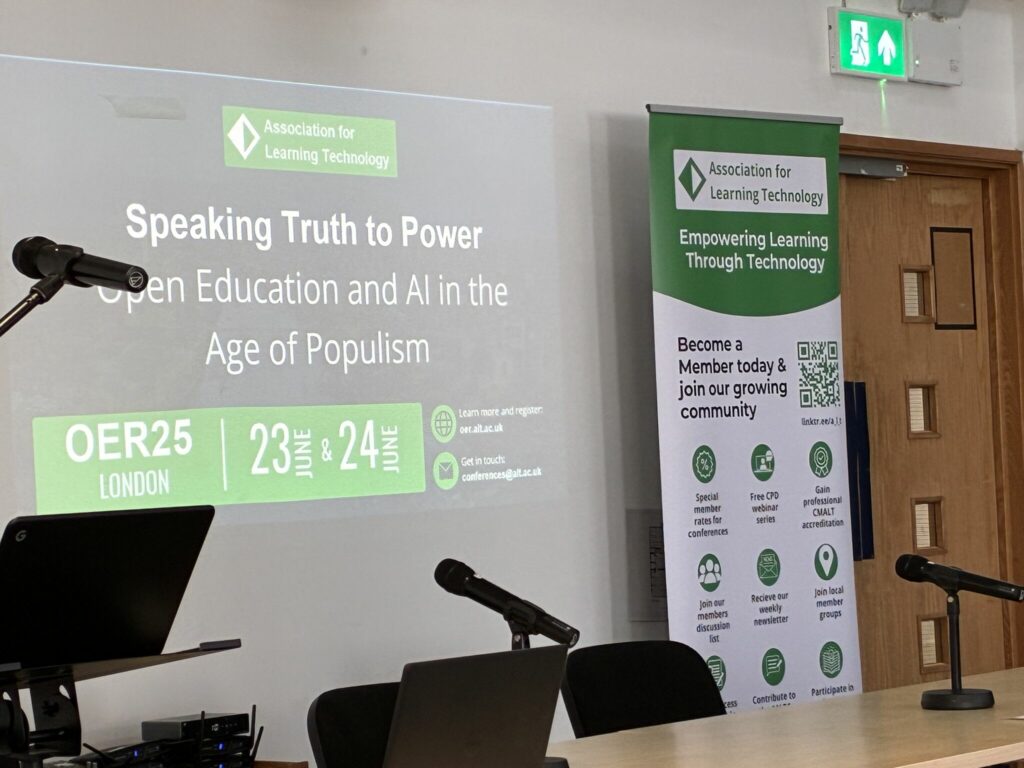
A later timing this year (June instead of April) for ALT’s Open Education Conference meant that for a few months last year, some wondered whether the conference would be held at all. Most happily –for history’s sake and for the future– the 15th annual Open Education Conference #OER25 was held in London last week, thanks to outstanding work by ALT, the conference committee, and conference co-chairs Sheila MacNeill and Louise Drumm.
The theme of the two-day conference squarely addressed the moment in which we find ourselves: “Speaking Truth to Power: Open Education and AI in the Age of Populism”. This post cannot adequately summarise the many contributions made at the conference (I refer you to the conference programme and range of #OER25 posts on social media). This is simply a brief summary along with my thanks to presenters whose sessions I attended, those whom I spoke with, and many whom I was not able to meet but who made valuable contributions. My feeling after the conference is that there is a broad understanding that the open education community/movement is in a time of reckoning, and that we must draw on the longstanding values of #open, as well as build on past/ongoing critical work in open/digital/higher education to address this crisis. I look forward to continuing conversations, collaborations and inspiration within the open education community and beyond.
Helen Beetham kicked off the conference with her brilliant keynote ‘When speaking truth is not enough: repurpose, rebuild, refuse’ –– a clear call for critical reflection on the open movement’s history and vulnerabilities, particularly in the context of generative AI. Critical work in open and higher education (exploring relations of power, commercial capture, hidden labour, coloniality and more) in recent years has shown how capitalism is in conflict with the commons. Generative AI developments have exacerbated these conflicts by capturing cultural data as private data. So how do we “speak truth to power”? Helen suggested actions in three areas: Repurpose (e.g. pedagogic hacking, small language models, Open Source AI), Rebuild (e.g. collaborative writing/assessment, making knowledge together live, using arts/studio practices, exploring frugal computing) and Resist (e.g. working within unions).
Joe Wilson, a long-time open education advocate, gave a lively and engaging Day Two keynote, Navigating change in the best interests of learners: A view from a hard-nosed optimist. Joe charted the development of open with reference to his own career in education, highlighting the core values of open education: access, agency, co-creation, and above all, equity. He noted current challenges including institutional inertia and legacy systems, competitive pressures, fear of sharing, and anxiety around AI. In a moving section of his talk, Joe gave special thanks to Lorna Campbell, co-founder with Joe of Open Scotland and “normally my sensible filter”. Lorna missed this year’s conference (for the first time) as she is recovering from throat cancer; Lorna wrote a personal post prior to the conference which was mentioned by both Joe and Sheila. Joe concluded his keynote in his inimitable style: “Stay critical. Stay kind. Stay open.”
At the conference, I co-presented Resistance and creativity: Generating AI Alternatives with Louise Drumm and Helen Beetham based on work we have done together with Rosemarie McIlwhan over the past year or so. At a “make-athon” workshop at #NLC2024, we invited participants to respond critically and creatively to provocations around generative AI. Following the response to the workshop, we created an openly licensed Generating AI Alternatives Toolkit so that anyone could facilitate a similar event. In our #OER25 presentation, we shared details of the toolkit and workshop outputs. (I also blogged earlier this year about this work.)
A highlight of #OER25 for me was Howard Scott‘s presentation based on his recently published article, Sumud as connected learning: Towards a collective digital commons in Palestine (JIME, 2025) which Howard co-authored with Monaster Ujvari, Aida Mohammad Ali Bakeer and Khaled Shanaa. As noted in the article:
…connected learning in Palestine is characterised by the metaphor of Sumud as a steadfast resistance to disruption. We propose that the metaphor of Sumud symbolises connectedness for displaced people, whose need for connected learning encompasses a cultural and critical pedagogy, heritage, and self-determination.
Howard began by citing the UNESCO report (2021) Reimagining our futures together: A new social contract for education, which noted that public education should not be dependent on private digital platforms due to issues related to privacy, surveillance, and lack of free expression and self-determination. Currently, algorithmic pathways, platform imperialism, and patterns of governance of digital infrastructures present acute challenges to sustaining education as a common good. As always, consideration of context is vitally important. In Palestine, the authors of Sumud as connected learning note that rather than education for social mobility, an important goal is education for safer life in situ, where people have become refugees in their own homeland. The authors propose a “digital commons toolkit” for educators of displaced and vulnerable people. This toolkit uses decentralised rather than colonising big tech platforms; promotes critical digital literacy; encourages the use of OER; and prioritises privacy, self-expression and resilience. I encourage all open educators to read this article. (After the presentation, I shared a link to the HE4Good chapter Advancing ‘openness’ as a strategy against platformisation in education by Tel Amiel and Janaina do Rozario Diniz, which addresses many similar issues.)
Paola Corti, Connie Blomgren and Jonathan Poritz took part in an engaging panel discussion: Toward the open future we make. This was framed as a response to last year’s OER24 keynote by Laura Czerniewicz and myself, The future isn’t what it used to be: Open education at a crossroads, in which we adapted the manifesto for Higher Education for Good for open education, outlining five tenets: (i) name & analyse the troubles of higher/open education; (ii) challenge & resist hegemonies; (iii) make claims to just, humane & globally sustainable higher/open education; (iv) courageously imagine & share fresh possibilities; and (v) make positive changes. From three different vantage points and contexts, Paola, Connie and Jonathan critically responded to these five tenets. I encourage you to explore their presentation; some themes arising in the discussion were the importance of critically engaging with generative AI (to understand its history, values and choices), actively claiming the values of open education, and recommitting to anti-racism, anti-colonialism, and DEI.
In another panel discussion, Keith Smyth and Bill Johnston shared work they did together with Sheila MacNeill, ‘Harnessing open education approaches in reviving the dissenting academy and situating informed citizenry within, through, and beyond formal education’. As in their co-authored book (2018) they drew on Freire’s concepts of public pedagogy and praxis. They observed three waves of OEP: MOOCs; education during the pandemic; and the current moment –– encouraging the open education community to ask itself: where is OEP now, and what is our aim? Again, drawing on Freire’s work, the authors suggested that the mission must be informed, agentic citizenry (e.g. Climate Assemblies).
Paul Stacey presented his recent essay The tragedy of AI — and what to do about it in which he uses the form of a classic tragedy to explore AI as a heroic/noble protagonist with fatal flaws, i.e. the tragedy of capitalism over the commons; taking without consent; demotivating sharing; breaking reciprocity; and bleeding open dry. Paul suggested that the downfall of AI is inevitable because AI’s fatal flaws are the very things it relies upon (the commons, consent, sharing, reciprocity, openness). So what is the possibility for catharsis, or action to address/prevent the tragedy of AI? Actions may or may not include social agreements and regulations, preference signals (e.g. CC Signals), reciprocity, and/or public AI. This session was a provocation for lively discussion in the room, and hopefully beyond.
It was a pleasure meeting Apurva Ashok and Amber Hoye (Rebus Foundation) after interacting online for some time. In ‘To AI or not to AI: The educator’s dilemma when creating OER supplemental materials’, Apurva and Amber encouraged open educators to ask ourselves how we are acting against imperialism, fascistic thinking, and inequitable practices; how we can use AI tools ethically and effectively; and how we can best empower students to use their humanity in the learning process. In ‘Finding stability through hope’, they shared the Rebus Foundation vision (a liberatory future where lifelong learning is valued as a public good) and values (reciprocity, authenticity, celebrating joy, agency, curiosity), acknowledging that these are under threat in the current political climate. All acts are political (Freire), and Apurva and Amber reiterated the value of working together and acting on our values in spite of the challenges.
Paola Corti gave an inspiring presentation on ‘A radical approach to MOOC design and dataset sharing’, describing radical open practice at her institution Politecnico Milano. Two of the over one hundred MOOCs created at Polimi Open Knowledge have been made available openly to be reused, repurposed and/or remixed. The Using OER in Teaching MOOC (CC BY) is designed for teachers and aligns with European ESCO learning outcomes. Polimi Open Knowledge has collaborated with Ukrainian universities to recreate this MOOC in the local language. The Enhancing Education Through Open Opportunities MOOC (CC BY) has been made available via a fully customisable and editable dataset (on Zenodo) so that any institution can download and tailor the course to their needs. This course has already been reused by Institute Superior Tecnico at the University of Lisboa. Paola acknowledged that the “maximising access to knowledge by minimising barriers” approach entails a great deal of extra work by the sharing institution, but that the skills learned and the extent of reuse have motivated all involved in the project.
Javiera Atenas and Leo Havemann presented ‘Building sustainable, resilient and inclusive OE ecosystems: OER as Public Goods’, referencing UNESCO’s (2024) Dubai Declaration on OER: Digital public goods and emerging technologies for equitable and inclusive access to knowledge. As they noted, open practices (including OER, OEP, open data, open science, open access and open government) collectively function as digital public goods, ensuring that knowledge, research and education remain freely accessible and sustainable for global benefit. This was a detailed and valuable session — I recommend following Javiera and Leo’s work in this area.
James Glapa-Grossklag and Joy Shoemate shared progress on the development of two courses at College of the Canyons on ‘Building AI literacy through OEP’. Both online courses are rooted in OEP. The professional development course for faculty includes: understanding AI capabilities and limits, ethical considerations, developing student-centred AI policies, and thoughtful integration of AI tools. The student course includes: using AI tools, understanding bias, and ethical considerations (e.g. copyright, privacy).
Beck Pitt provided an informative update on GO-GN, the Global OER Graduate network for doctoral researchers whose research projects include a focus on open education. Beck shared the combined (and impressive) Google Scholar metrics for GO-GN students and alumni, and news that GO-GN Regional Hubs will be piloted in 2025. Stay tuned for updates at https://go-gn.net/.
Sadly, I missed many other conference sessions due to scheduling conflicts. I would love to have seen Judith Pete and Jenni Hayman on ‘Hopeful, positive, global generative AI for OER’; Kate Molloy and Clare Thomson on ‘Fighting the good fight – go rogue or go home’; and Susanna Kohonen on ‘Redefining language learning and assessment in the age of AI’. I also missed seeing some stalwarts of previous #OERxx conferences who did not attend this year including Lorna Campbell, Laura Czerniewicz, Frances Bell, Maren Deepwell and Martin Weller –– you were missed.
I left #OER25, however, with a renewed sense of hope about the seriousness with which many in the open education community are facing our current challenges. Despite different opinions on the path(s) forward, experienced and newer open education scholars expressed a commitment to open values, a willingness to take part in difficult conversations, and a recognition of the stakes of this moment in education and in wider society.
Warmest thanks again to ALT, the conference committee, the wonderful co-chairs, and all who presented and participated.
Onward.
Image source: Joe Wilson (LinkedIn)
Thanks for sharing another excellent summary. I was lucky enough to chat with Beck Pitt during EDULEARN in Palma where she recapped some of the GO-GN initiatives.
Thanks Bernie… it was great to be at the conference again, despite these chaotic times. Hope you are doing well.