For the past two years, it has often felt that we are living inside an unceasing clamour of claims, assertions, critiques, and questions about generative AI. What does generative AI mean for teaching, learning, assessment, and research? What does it mean for the future? What does it mean for the planet? And what does it mean for individual lives: teachers, students, and especially those whose humanity continues to be the subject of debate?
In an effort to break through the noise, a few of us worked together to do something very simple, and very human. We created and facilitated an inclusive workshop space, inviting participants to personally reflect on these ideas and questions, and to create an artefact to express their ideas. In the form of a “make-athon” workshop at the Networked Learning Conference 2024, Louise Drumm, Helen Beetham, Rosemarie McIlwhan and I worked together with participants to reflect on how generative AI technologies affect our humanity – and to contribute a creative output:
These new computational approaches – so far confined to the largest and most capital-intensive tech companies – can generate human-like content at an unprecedented speed and scale. As an alternative, we will produce knowledge at a human speed and scale, through creative collaborations in a range of media, including generated, ‘made’ and found contents. Our goal is not only to understand and critique computational generativity, but to reconnect with ‘generation’ as a curious, expansive and generous practice in education. (Drumm et al., 2024)
We designed the workshop Generating AI alternatives: collaborating and creating intersections (Drumm et al., 2024) to include both online and in-person participation, with opportunities to work in different ways (e.g. quietly, in conversation with others, with physical materials, with digital materials) but in the same temporal presence. As part of the workshop design, we decided that each of us would create a short provocation “with, against and around generative AI” – to stimulate and maximise the time for thinking, connecting and creating during the workshop.
Link to Generating AI Alternatives workshop toolkit (added 28-Feb-2025)
Provocations
Our intention was that the provocations could give an opportunity to step back from (and push back against) institutional agendas and knee jerk responses to prevalent ‘generative AI in HE’ narratives. As workshop designers, we are four individuals in three different countries, each with unique, situated viewpoints. We developed our provocations independently, after discussing the following as potential themes –all in relation to generative AI in higher education– social justice, human rights and ethics; resistance and digital decoloniality; feminist pedagogies; posthumanism; sustainability; open educational practices; platform capitalism and labour.
Here are links to all four provocations (short videos): Helen Beetham’s provocation; Louise Drumm’s provocation; Rosemarie McIlwhan’s provocation; and my provocation with a short summary below:
I chose to explore language. When we speak of generative artificial intelligence (i.e. generative AI, GenAI, GAI), what are we actually saying, and thus thinking? This grew out of a reflection on Lera Boroditsky’s (2011) observation that “changing how people talk changes how they think.” In everyday English, generative is defined as capable of producing or originating something. In the field of AI, generative refers to the ability to generate text, audio, video and/or images by applying a finite set of rules to linguistic input to predict and produce recognisable output. The word ‘generative’ has different definitions in other contexts, however. In Erikson’s (1950) psychosocial theory, for example, generativity is associated with a key stage in personality development, and encompasses the generation of new beings, new products, new ideas, and self-generation (i.e. identity development). Erikson’s generativity can be said to involve concern for others and the desire to contribute to future generations. Feminist generative theory also contributes to the future, but can be used constructively in present politics also, i.e. it informs both theorization and current praxis (Boux, 2016). While feminist generative theory is developed for the future, often in the political arena, it is built through engaging in a process of activism (Mack-Canty, 2004). In my provocation, these definitions are presented simply and sequentially for consideration, before posing the question: What alternative imaginaries of generative AI are possible?
Designing the workshop
Overall, our aim was to create an energising and supportive workshop space, both in-person and online, where ideas could flow and expression could take different forms. Participants were invited to “reflect collectively and respond critically to the emerging ethical, epistemological and relational challenges of generative AI. No special knowledge is required, just a willingness to collaborate, create and be curious” (Drumm et al., 2024).
In addition to creating our individual provocations, Louise applied for ethical approval for the workshop so that participants could consent to share their work and be co-creators in any subsequent publications. We created a participant consent form, an online meeting space, and a Padlet to which participants could add digital versions of their creative outputs. The workshop was designed to run simultaneously face-to-face and online, with multiple facilitators in each space. It was important to us that anyone could participate in the workshop, so while on-site participation was limited to Networked Learning Conference participants, online participation was open to all (requiring only online registration and completion of the simple participant consent form).
We prepared a wide range of materials for “making” so that participants could focus on creating artefacts to express their ideas. In-person materials included crafting materials (e.g. scissors, scrap paper, glue, yarn, scrap material, magazines and other texts, pencils and markers) and story cubes. Online materials included a blackout poetry maker, creative language prompts, links to various language models, and other resources. Participants were also encouraged to find and generate their own materials.
Note: We are currently putting the final touches to a Workshop Toolkit, providing openly-licensed materials for anyone who may wish to run a similar workshop. I will add the link here when it is published.
Workshop reflections
The 90-minute workshop was a blur of parallel activities, with just over 100 participants (98 online and 8 onsite) and five facilitators. While time at the start and end of the workshop was shared and synchronous – viewing the provocations at the start and sharing reflections at the end – most of the workshop time was devoted to participants reflecting and responding to the provocations by making. The diversity of creations was amazing, including paintings, drawings, AI images, poetry, stories, song. We do not venture to summarise or analyse all that was created. We are grateful, however, to Eamon Costello for sharing his reflections after the workshop:
I put my thoughts down for a little while and took up some scissors. After cutting for a while I lay down the scissors and took up the glue. / On I worked in this way. / I suppose I was hoping that what I was doing might become some thanks, however inadequate, for the offerings of Catherine, Helen, Rosemarie, Louise and everyone else. / “Everyone is trying”, I thought “and so am I”.
I could feel my body trying to regulate itself, trying to adjust to the social requirements I was asking of it at the conference, seeing if it could use the work to climb down a little, to allow a conversation with sensation — the one that thought is normally so quick to talk over. / Thinking did not stop for me. / Language is a virus. / Words were still streaming through my mind but I could feel a few more of the gaps between them. / And when I looked into the gaps, though small and brief, I could see the sun.
And as soon as you see the sun you feel it too. / And I remembered what is good and what is simple and what is true; what is forever beyond language and its machines. / I remembered that the sun is always shining.
During the plenary session at the end of the workshop, participants’ reflections illuminated so much for us: the appreciation of shared “slow” space to reflect, think and create; the valuing of unique, human responses; the power of nontextual and atextual ways of thinking and communicating. All of these open avenues for alternative ways of thinking about the issues presented by generative AI in our lives.
If AI technologies are “making the future”, we know that they can be reimagined – so that we can create better futures, more sustainable futures, and more just futures. This requires awareness of power relations, human rights, and ethics, as well as contextualising, connection, relationships, and much more.
I am immensely grateful to Helen, Louise and Rosemarie for their wisdom and generosity over many months, and to the participant “makers” in the workshop for their willingness to experiment and beautifully human responses. I also thank many others whose work has contributed to my thinking and understanding of these issues, including all cited in our NLC paper (Drumm et al., 2024) and many more.
This post is part of a collection of blog posts (one by each of the workshop designers, initially); links will be provided here as they are published. In addition, a co-authored publication, together with workshop participants, is planned.
Link to Generating AI Alternatives workshop toolkit (added 28-Feb-2025)
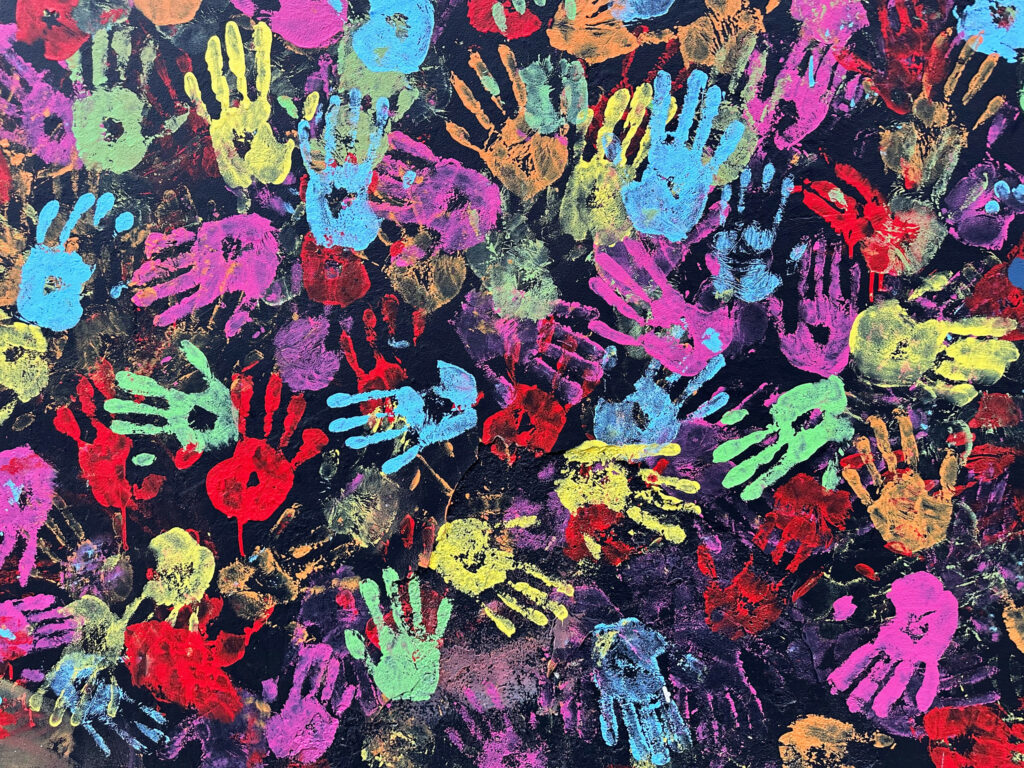
Image: ‘The Human Touch’ CC0 by @cogdog (Flickr),